Pickleball basics: The kitchen scared me. Then I learned two tiny rules and everything changed.
I remember standing at the net, heart thumping, imagining invisible signs that said “Danger — do not enter!” It turned out the kitchen (the non-volley zone) is less a forbidding place and more the small arena where games are quietly won. This zine is the map I wish I’d had that first day: rules in plain language, the four shots you really need, three drills to start, and a printable pocket cheat to carry to the court.
What you’ll be able to do after reading
- Explain the basic rules & scoring of pickleball basics and rules.
- Point out court zones (including the non-volley zone / kitchen).
- Perform 4 fundamental shots: serve, return, dink, volley (plus the third-shot drop).
- Run 3 starter drills and a 45-minute beginner practice session.
Pocket cheat preview (zine cover)
Baseline  |---7ft NVZ---|  Net  |---7ft NVZ---|  Baseline
[Left]                 [Center]                 [Right]
 5 must-know rules:
 • Double-bounce rule (serve + return bounce)
 • No volleying in the kitchen (NVZ = 7 ft)
 • Serve underhand, diagonal, one attempt
 • Court = 20' x 44'
 • First to 11 (win by 2), rec scoring
Quick primer: Pickleball basics — 5 things to memorize
Small list. Big results. Keep these in your pocket (literally or mentally).
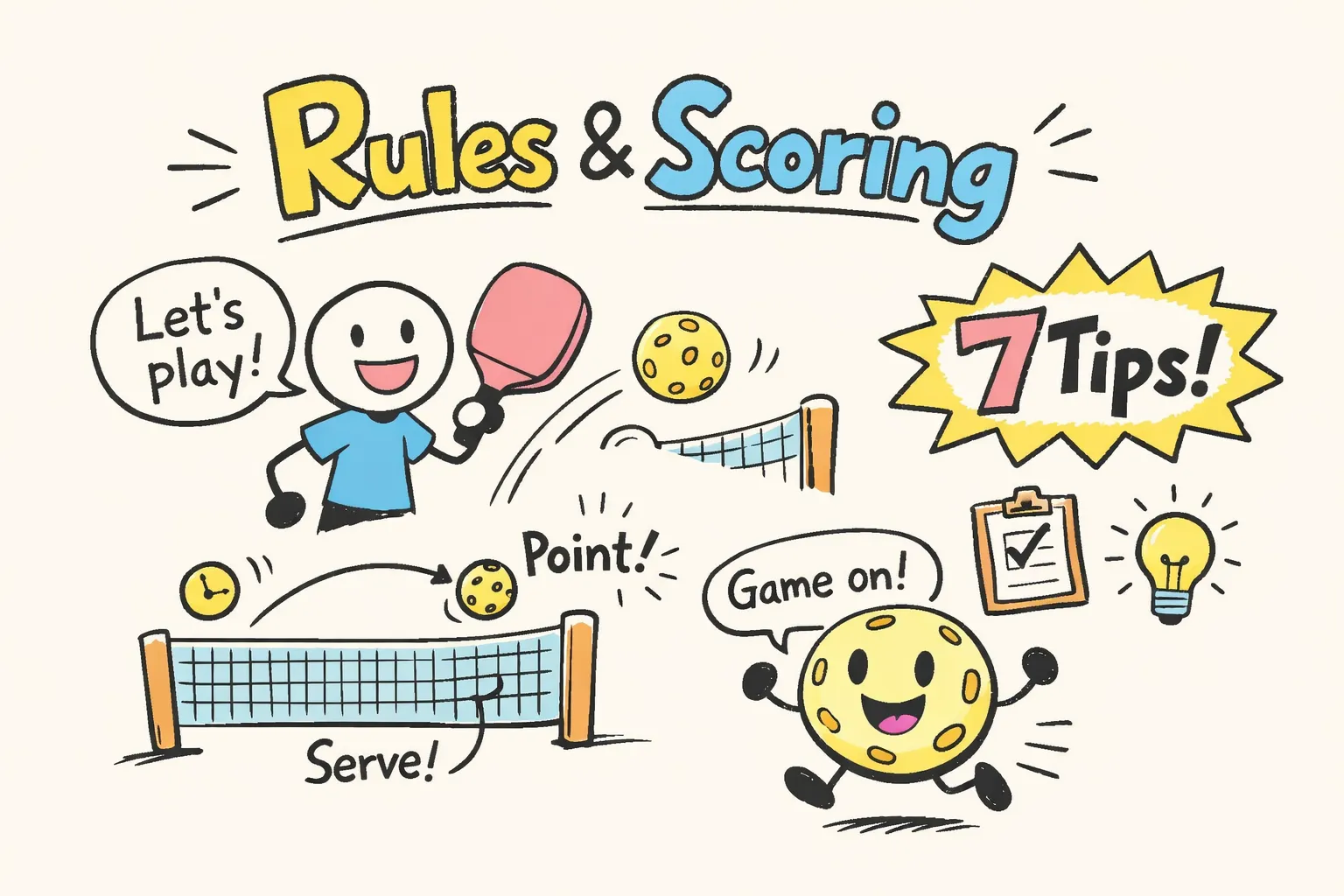
- Double-bounce rule: After the serve, the ball must bounce once on each side before anyone volleys.
- No volleying in the kitchen: The non-volley zone (NVZ) is 7 feet from the net on both sides — you can hit a bounce in there, but you can’t hit it out of the air while standing in it.
- Serve underhand only: Paddle below wrist, contact below waist, diagonal to the opposite service box, and only one serve attempt in casual play.
- Court size: 20′ x 44′ for singles and doubles (same court, same lines).
- Scoring: First to 11, win by 2 (casual doubles often uses side-out scoring where only the serving team can score; note rally scoring exists for tournaments).
Try this: Stand on the baseline, swing underhand without the ball to feel the serve motion — keep it low and gentle. That’s the motion you’ll start with.
Pickleball rules for beginners (serves, scoring, faults & the kitchen) — deep dive
Rules feel formal, but they simplify to a few moments you can remember mid-game. I’ll break this into small sections.
Serve rules (easy checklist)
- Underhand only: The paddle must be below your wrist when it strikes the ball, and the contact point must be below the server’s waist. What does “below the waist” feel like? If you can see your belly-button, aim lower than that — a relaxed, low upward swing.
- Feet & baseline:The server must be behind the baseline at contact — at least one foot must be behind the baseline/ground behind it. Don’t stand on the line.
- Diagonal serve: Serve to the opposite service box (from right to left or left to right). The ball must land inside that service area.
- One attempt (recreational): In most rec play, you get a single serve attempt. Tournaments may have different allowances.
- No spin manipulation with the body: You can impart spin with the paddle contact, but you can’t do weird hand/body tricks to roll the ball before contact; referees call close calls as faults.
Double-bounce rule (why it exists)
After the serve lands, the receiving team must let it bounce once. Then the serving team must return it and let it bounce once. After those two bounces, the ball can be volleyed (hit in the air). Why? It prevents immediate smashes and gives both teams time to get to the net. Two examples:
- Example A: You serve → opponent lets bounce → you volley too early (fault).
- Example B: You serve → opponent returns off the bounce → you wait and hit a low groundstroke or third-shot drop so you can safely approach the kitchen.
Scoring basics (simple doubles example)
Casual doubles: first to 11, win by 2. Traditionally, only the serving side scores (side-out scoring). In doubles, each team has two servers per turn at service (except the first service sequence of a game). A common way to track is “YourTeamScore OpponentScore ServerNumber” — for example, “3-2-2” means your team has 3, opponents 2, and the second server of your team is serving.
Note: As of recent rule updates (2026 rulebook), rally scoring formats are formalized for certain events — that means every rally could produce a point. Recreational play and many club games still use the classic side-out doubles scoring. For the official changes in 2026, see the 2026 USA Pickleball rule changes overview.
Faults beginners often make (and quick fixes)
- Volleying in the NVZ: Fault. Fix: Take an extra half-step back and hit the ball after it bounces.
- Stepping on/over the NVZ line while volleying: Fault. Fix: Practice small shuffles and keeping weight back when punching volleys.
- Volleying before the two-bounce rule: Fault. Fix: Count “1-2” after serve to remind yourself of the bounces.
- Serving into wrong box: Fault. Fix: Mark the diagonal line with a small target during practice and consciously aim there.
- Foot fault on serve (stepping forward): Fault. Fix: Keep at least one foot behind baseline until after contact.
- Hitting out of bounds: Fault. Fix: aim for depth, not power; pick a target and go for consistency.
- Extra ball falling from pocket: Fault if visible. Fix: empty pockets before you play.
The Non-Volley Zone (the Kitchen)
The NVZ is the 7-foot strip on both sides of the net (so 14 feet total across the net). The rule is simple-sounding and subtle in practice:
- You cannot volley while standing in (or touching) the NVZ (that means hitting the ball in the air). You can step into the NVZ and hit a ball that has bounced.
- Momentum rule: If you volley the ball and your momentum carries you into the kitchen and you touch it, that’s a fault. So take the punch — but don’t step forward and land in the kitchen.
- Tip: Think of the kitchen as “no flying hits here”; it’s the space for delicate fights — dinks and soft touch.
Personal note: I thought the kitchen was a scary zone I should never approach. Turns out it’s the most important 7 feet on the court — where patience, not power, wins points.
Pickleball basics — court, net & measurements
Here are the numbers you want to remember and a quick sketch to carry in your head (or pocket).
Official dimensions (fast facts)
- Court: 20 feet wide × 44 feet long (same for singles and doubles).
- NVZ (kitchen): 7 feet from the net on each side.
- Service boxes: Each side has two service boxes, 10′ × 15′ from NVZ line to baseline (divided by a centerline).
- Net height: 36 inches at the sidelines (poles), 34 inches at the center.
- Line width: 2 inches (measurements taken to outer edges).
- Total play area recommended: at least 30′ × 60′ for safe margins.
If you want a deeper breakdown of official court measurements and recommended play-area margins, check this detailed guide on pickleball court dimensions.
Why the dimensions matter
- The narrow 20′ width makes placement and angles important — don’t get overconfident trying to blast past someone.
- NVZ = 7′ is a compromise: close enough to the net to make dinking meaningful but large enough to prevent easy net kills.
- Net height (34–36″) affects the third-shot drop — you want a shallow arc that lands in front of the opponent’s NVZ line.
Mini diagram (printable-friendly)
  Sideline
  |-------------------- 20' --------------------|
  |  NVZ  |    Service Area    |    NVZ  |
  | 7ft   |    10' x 15'       |  7ft   |
  Baseline                                     Baseline
            (44' total court length)
Shoes & safety: Wear court shoes with lateral support — running shoes don’t always stop side-to-side slips. Bring water, sunscreen, and a towel.
Mini-check: Can you point to the kitchen and baseline with your eyes closed? If not, walk the lines once — muscle memory helps.
Pickleball basics: gear for beginners (short & practical)
Gear is confusing because there are so many options. For beginners, favor forgiveness, comfort, and trying things in person.
Paddle basics
- Shape: Standard or wide-body paddles give a larger sweet spot — good for beginners.
- Weight: Try paddles around ~7.3–8.5 oz (lightweight for control and less arm fatigue). If you get sore quickly, try lighter; if you want more stability on punches, slightly heavier.
- Grip size: Pick a grip that feels comfortable; a typical starting range is 4.1–4.25 inches. If it feels small, add an overgrip.
- Core & face:Polypropylene or foam cores are forgiving and give good control. Graphite or composite faces offer feel.
- Try before you buy: Demo days and local shops are gold — your wrist will tell you what weight & shape you like. For a short primer on choosing a paddle, read this guide onhow to select a paddle.
Ball types
Outdoor balls are harder with smaller holes to fight wind; indoor balls have larger holes and higher bounce. For learning, consider:
- Indoor training balls (or foam): Slower and more forgiving — great for dinks and drills.
- Outdoor starter balls: GoSports GS40 or Franklin X-40-type balls are common choices for beginners — durable and predictable.
Price bands (simple)
- Starter paddles: ~$40–$100 — plenty of options to learn on.
- Mid-range: $100–$200 — better build, more consistent response.
- You don’t need a $200 paddle to learn: feel beats marketing. Buy something comfortable. For curated beginner paddle recommendations, see thisbest pickleball paddle for beginnersguide.
Try-before-you-buy: Bring your hand and swing at a demo day. Move around with the paddle — don’t just hold it still.
Print checklist: paddle, spare balls, court shoes, water, sunscreen, towel.
How to play pickleball: 4 fundamental shots with step-by-step cues
Mental model: The game lives in two places — baseline rallies and the kitchen. Your shots move you between them. When you see a chance to take the kitchen, you move forward carefully; when you want to reset, you hit deep from the baseline.
1. Serve (underhand)
- Stance: Sideways to target, feet behind baseline, weight slightly forward.
- Grip: Loose but controlled — not death grip.
- Motion: Low swing, paddle below wrist at contact, contact below waist, upward arc. Think gentle arc more than power.
- Aim: Deep or to opponent’s weak backhand; serve diagonally into opposite service box.
- Common mistake: Hitting too hard or flat — you’ll lose control. Keep the arc.
- Mini drill: 10 serves to a taped target; repeat until 6/10 land in.
2. Return of serve (block & deep return)
- Ready: Slight bend, paddle up, light on your toes (split step when serve is struck).
- Block: Use the incoming pace; meet the ball with a compact motion and a slightly closed paddle face to keep it low.
- Aim: Deep to the baseline or cross-court to push opponents back.
- Common mistake: Swinging early and popping the ball up. Fix: keep a short arm, let the ball come to you.
- Mini drill: Partner serves; return deep 10 times, switching sides.
3. Dink (soft NVZ shot) — the heart of rallies
You’ll win more points by mastering the dink than by hitting flashy winners. It’s about touch, not power.
- Grip: Light — let the paddle absorb the speed.
- Contact: Out in front, soft push, aim just over the net to land in the opponent’s NVZ.
- Body: Low stance, knees bent, small controlled movement. Move your feet; don’t reach.
- Why it matters: It forces errors in the NVZ and creates space when opponents overcommit.
- Common mistake: Reaching and slicing — causes pop-ups. Fix: step to the ball and shorten your stroke.
- Mini drill: 5-minute dink-to-dink rally with partner; aim for 20 consecutive shots (or a time goal).
4. Volley (net punch)
- Ready: Paddle up, weight slightly forward, short on your feet.
- Contact: In front of your body, short wristy punch — no big backswing.
- Don’t: Step into the NVZ and volley. If you must go forward, wait until the ball bounces.
- Common mistake: Big swing that misses timing. Fix: shorten the motion and use body forward push.
- Mini drill: Partner tosses soft balls at net height; practice blocking solid volleys (30 reps).
Transition: Third-shot drop (baseline → kitchen)
The third-shot drop is the secret sauce for many players learning how to take the net. It’s a soft groundstroke from the baseline that bounces in the NVZ so you can approach the kitchen.
- Get back to the baseline after serve/return. When you hit the third shot, shorten your swing, open the face slightly, and aim for a gentle arc that lands in the opponent’s NVZ.
- Progression: start with a slow drop from mid-court to the NVZ, then gradually increase distance and add movement to approach post-drop.
Mini visual (three frames)
[Serve] ------> [Return] (bounce) -----> [Third-shot drop] (bounces in NVZ) ----> [Approach net]
3 starter drills + a 45-minute beginner practice plan
Drill #1 — Dink Ladder (touch & consistency)
Setup: Partners at NVZ, 6–10 feet apart.
- Goal: 50 consecutive dinks (or 2 minutes of continuous rally).
- Progression: Add targets left/right, then require a step between shots.
- Coaching tip: Count quietly — if you stop counting, reset. Focus on feet and soft contact, not power.
Drill #2 — Serve & Return Target (reliability)
Setup: Mark target squares in the service box and deep baseline.
- Do 10 serves to the target, partner attempts returns to a deep target. Swap roles.
- Progression: Reduce target size; keep score (1 point for hitting small target, 0 otherwise).
Drill #3 — Third-shot drop → transition → dink rally
Setup: Server, returner, and a net player or cones marking NVZ. Sequence:
- Serve → Return (bounce)
- Third-shot drop (aim NVZ)
- Both players approach the net and begin a dink rally
Goal: Smooth approach and control into the kitchen; do 8–12 sequences.
45-minute beginner practice (timed)
- 0–8 min: Warm-up — dynamic movement, short volleys, light jogging.
- 8–20 min: Serve & Return drill (Drill #2).
- 20–35 min: Dink Ladder & NVZ work (Drill #1).
- 35–42 min: Third-shot drop practice + approach (Drill #3).
- 42–45 min: Cool-down + quick recap: play 3 mini-games to 5 and reflect on one thing to improve next time.
Solo practice tips: Use a wall for returns and soft volleys, tape targets on the wall for serve practice, and use foam balls to slow play down.
Common beginner mistakes and quick fixes
Here are the seven most common things I see beginners do — and tiny fixes that worked for players I coached.
- Trying to hit winners from the baseline too early. Fix: Prioritize depth and consistency — practice hitting deep rallies before aiming for winners.
- Stepping into the kitchen and volleying. Fix: Practice the “no-volley” stance: feet shoulder-width, paddle up, back foot ready to land if you lunge.
- Incorrect serve contact (too high or wristy). Fix: Slow down your serve; film one rep and check that contact is below waist.
- Gripping the paddle too tight. Fix: Squeeze only on contact — hold the paddle like you’re holding an egg between fingers and palm.
- Rushing the third shot (too flat). Fix: Use a soft swing and aim for the NVZ to allow safe approach.
- Feet too static during dinks. Fix: Small shuffle steps — use your feet to get into position instead of reaching.
- Not clearing pockets/full pockets with balls. Fix: Check pockets each time — an extra ball in pocket is a fault and it’s annoying for everyone.
Mini debugging diary: One beginner kept popping dinks up. We put a line of tape 3 ft in front of them and told them to step not reach — suddenly 70% fewer pop-ups. Small experiments win.
Safety, etiquette, and where to get help (Master The Dink pitch)
Quick court etiquette
- Call “out” promptly and honestly.
- Rotate courts fairly if there’s a line (win → stay on for a point or two, follow local club norms).
- Respect beginners — everyone was new once.
- Share balls and clean up your area.
Safety
- Warm up: shoulder circles, hip openings, ankle rolls, light jogging.
- Hydrate and use sunscreen for outdoor play.
- If you feel elbow/shoulder pain, stop — technique adjustments and rest beat pushing through pain.
- Use proper shoes to avoid ankle rolls.
Where to get coaching & gear
If you want help speeding this up, Master The Dink provides:
- Resources, Master The Dink— beginner coaching materials, printable zines, and gear reviews.
- Beginner coaching sessions (30–60 min) that tailor drills from this zine.
- Gear reviews and curated paddle deals to find what fits you.
- Printable pocket zines and community support to ask questions and share wins.
Book a short beginner lesson to get immediate feedback on serve mechanics and the third-shot drop — two things that accelerate improvement fast. To schedule, visit our Contact, Master The Dink page.
Quick pocket zine & cheat-sheet (printable)
Make a one-page printout and fold it into your pocket. Here’s a suggested layout (all fit on one page):
- Top: Mini-court diagram with NVZ and service boxes labeled.
- Middle-left: 6 one-line rules (double-bounce, NVZ, serve, faults, scoring, court size).
- Middle-right: 4 shot cues (serve, return, dink, volley) in two-line prompts.
- Bottom-left: 3 drills + timings (Dink Ladder, Serve/Return Target, 3rd-shot drop sequence).
- Bottom-right: “Need a coach?” micro-bio for Master The Dink + CTA to book (see ourAbout, Master The Dinkpage).
Suggestion: Save a small PNG of the cheat-sheet to your phone and print a PDF for the court bag.
Wrap-up & next steps
You don’t need perfect technique to have fun. Focus on control, court awareness, and the kitchen. The three things to work on first are:
- Serve & reliable return (get the game started cleanly)
- Dinks & NVZ control (win the net)
- Third-shot drop (safe approach to take the kitchen)
3-week starter plan
- Week 1: Serve & return fundamentals — 3× per week, 10–15 minutes focused practice.
- Week 2: Dinks & NVZ — add a daily 5–10 minute dink ladder session.
- Week 3: Third-shot drop + approach — practice the sequence and then play mini-games.
Final CTA: Want the printable pocket zine and help getting started? Master The Dink has a downloadable zine and easy booking for a 30-minute beginner lesson — we’ll tailor drills from this guide and point you to the right paddle. Visit Home, Master The Dink to learn more and get started.
You did it! You’ve read a pocket zine on pickleball basics. Bring a friend, try the 45-minute plan, and celebrate the tiny wins — like your first reliable deep return or your first 20-dink rally. They feel huge.
Appendix — Quick FAQ (short answers)
How is doubles scoring different? In traditional side-out doubles, only the serving side scores; each team gets two servers before a side-out. See the scoring example in the rules section. For more questions, check our FAQ, Master The Dink.
What is a let? In recreational play, a serve that hits the net and lands in the correct service box may be replayed depending on local rules. Tournaments follow official rulebook procedures — check the event rules.
Can I volley off a bounce? Yes — once the ball has bounced (after the double-bounce requirement is satisfied), you may volley if you are not touching the NVZ.
Further reading: USA Pickleball official rules for detailed edge cases, local club pages for courts and demo days, and Master The Dink for coaching and printable cheat-sheets.
Leave a Reply